What I Learned About Real Broom Making at Shaker Village of Pleasant Hill
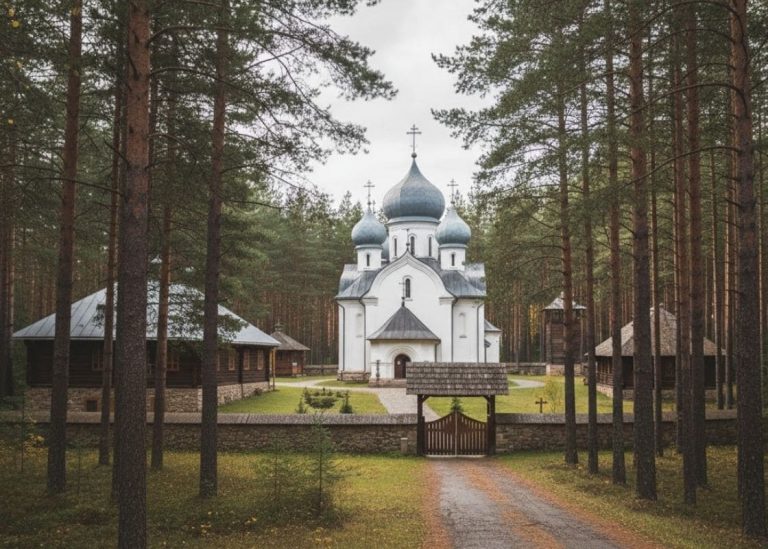
We arrived at Shaker Village of Pleasant Hill in June. Kentucky had that soft late-morning light, the kind that makes wood barns look warmer than they are and makes the countryside feel patient instead of empty. The village sat quietly beyond the parking area, old buildings spaced with intention, white fences, worn paths, and a…
We arrived at Shaker Village of Pleasant Hill in June. Kentucky had that soft late-morning light, the kind that makes wood barns look warmer than they are and makes the countryside feel patient instead of empty.
The village sat quietly beyond the parking area, old buildings spaced with intention, white fences, worn paths, and a calm order that didn’t feel staged.
Amanda and I had been on the road long enough to understand that the smallest chores become the biggest mood-setters in a van. If the space is messy, you feel it everywhere. If it’s clean, you sleep better.
That’s why we came. Not because we suddenly became broom collectors, but because I was tired of plastic travel brooms that bend, shed, and snap at the worst time.
I wanted to see how people used to make something as ordinary as a broom and make it last.
Walking Into a Place That Still Smelled Like Work
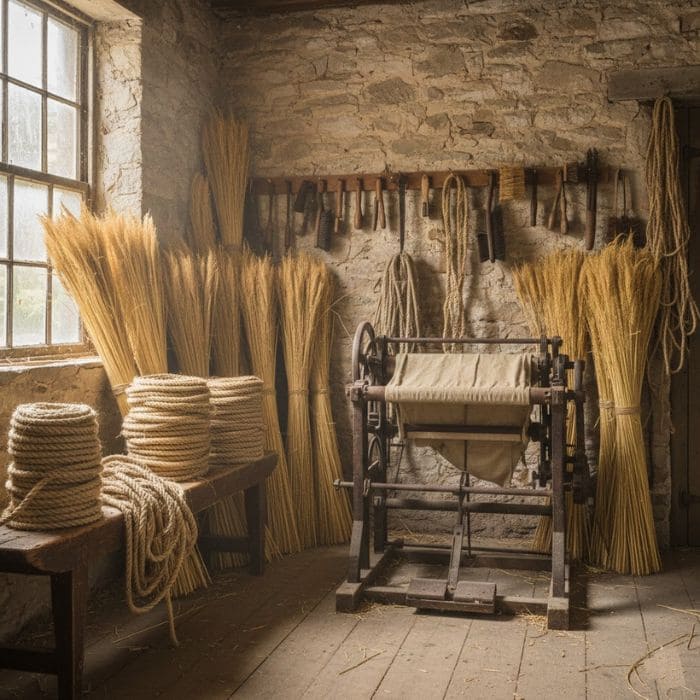
The first thing I noticed was the smell. Old wood, dust, and something dry and earthy that reminded me of hay.
Bundles of broomcorn stood upright along the wall like sheaves of grain, pale gold and sun-cured, and beside them were coils of hemp cord, rough and thick, ready to be pulled tight.
A staff member in plain work clothes moved through the space the way someone does when they’ve repeated a process a thousand times.
Amanda ran her fingers lightly over a bundle of broomcorn and whispered, “This is sturdier than I thought.” The fibers were stiff but not brittle, and the ends had a natural taper that made it obvious why this plant was used. It was designed by nature for sweeping.
The Broomcorn Wasn’t Random
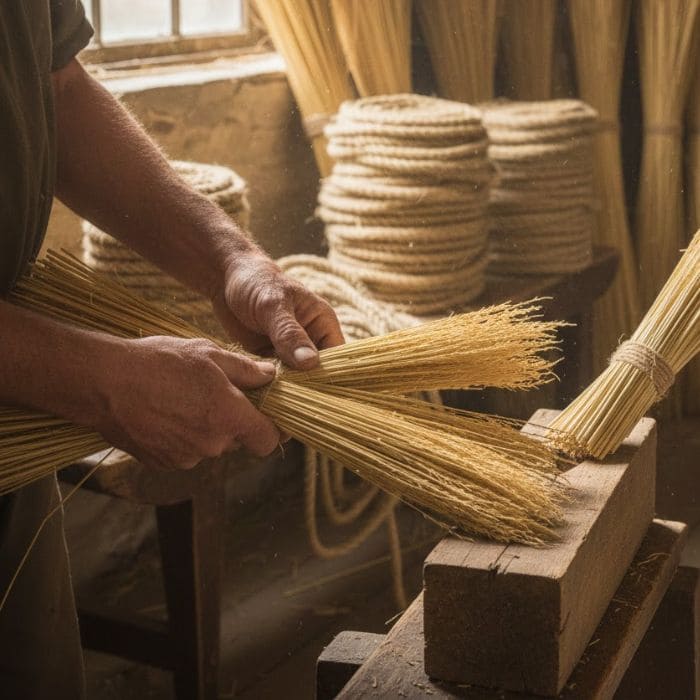
The maker didn’t grab broomcorn in a casual handful the way I would. They sorted it first, pulling longer fibers from one bundle, shorter from another, lining them up so the tips fell evenly.
It was the kind of detail most visitors probably miss, but I couldn’t, because the moment you live in a van, you understand that uneven materials create uneven results.
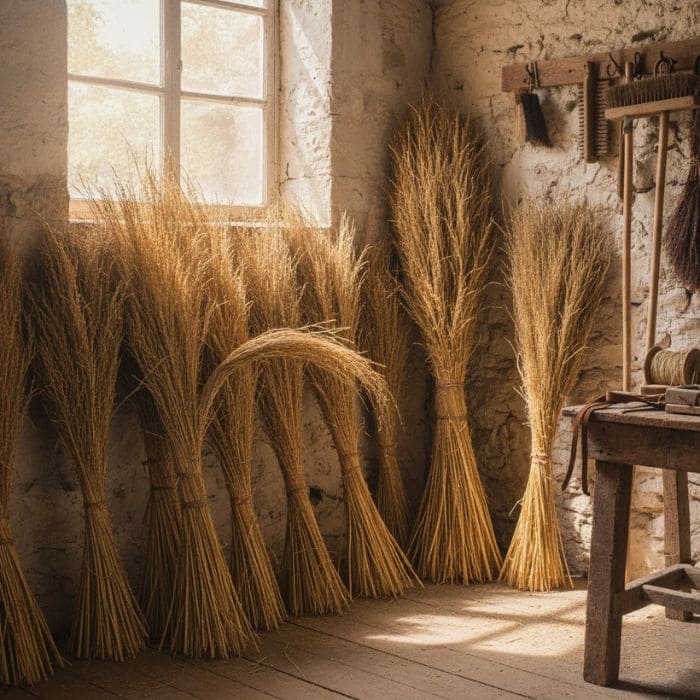
The broomcorn wasn’t corn at all, I learned that quickly. It’s a type of sorghum grown for its long seed heads, and what made this broomcorn “good” wasn’t just length, it was consistency. Fibers that were too thin would break, while fibers that were too stiff would snap.
The bundles in that workshop had been dried carefully so they still had a slight flexibility, like they could bend under pressure and return.
Watching the sorting felt like watching someone prepare ingredients for a recipe. The broom was only going to be as good as the broomcorn chosen at the start.
The Handle, the Bundle, and the Moment It Became One Tool
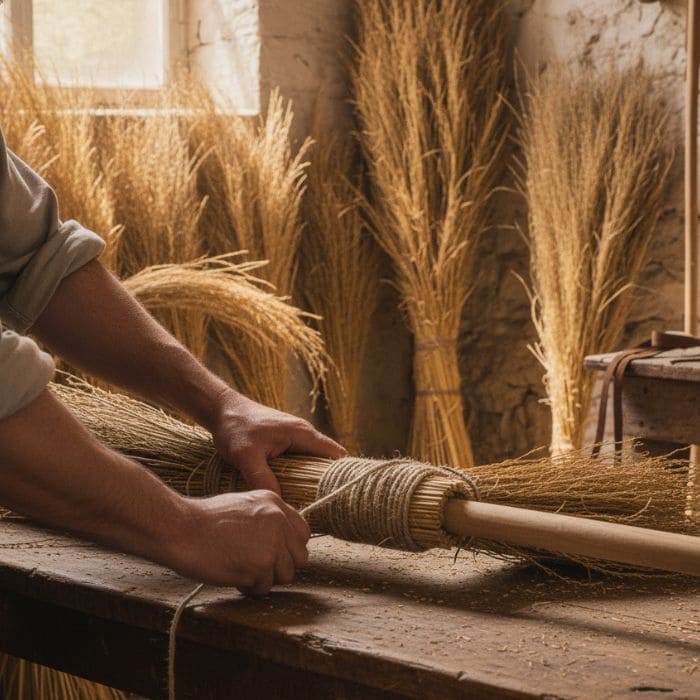
A wooden handle lay on the work surface, smoothed and simple, no glossy finish, no branding, just wood meant to be held. The maker positioned the broomcorn against the handle and began the first binding with hemp cord.
This was the moment I realized why hemp matters.
Hemp cord doesn’t slide. It bites and it grips itself. Every wrap tightened the bundle, compressing the broomcorn into a strong core.
The maker pulled hard enough that I could see their forearm flex, but not so hard that the fibers crushed. There was a balance there, the kind of tension you develop only through repetition.
The cord wrapped around and around with even spacing, and with each pass, the broom looked less like plant material and more like a tool taking shape.
The sound was subtle, a dry rasp of cord against broomcorn, the faint tap of handle against the workbench, the kind of sounds that make you feel calm because nothing is rushed.
Amanda stood beside me quietly, watching like she was looking at something fragile, even though the whole point was durability.
The Part That Surprised Me: Building Thickness in Layers
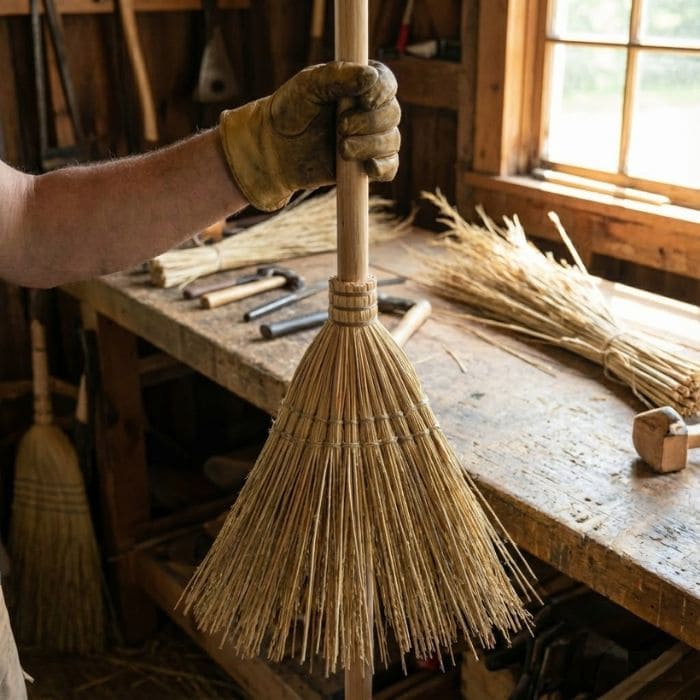
The broom wasn’t made from one bundle and finished. The maker layered additional broomcorn around the core, thickening it evenly, rotating the broom as they worked so the shape stayed balanced.
It reminded me of how you build a strong fire. You don’t throw everything into one spot and hope. You layer carefully so the structure holds.
I noticed they kept checking the tips, making sure the ends lined up. If the sweep line was uneven, the broom would drag and wear wrong. It wasn’t about looking nice. It was about performance.
That detail hit me hard because I’ve used cheap brooms that scatter dust instead of moving it, brooms that twist in your hand because the head is loosely attached. This was the opposite of that. This was made to be honest.
Flattening the Broom: The Step That Changed Everything
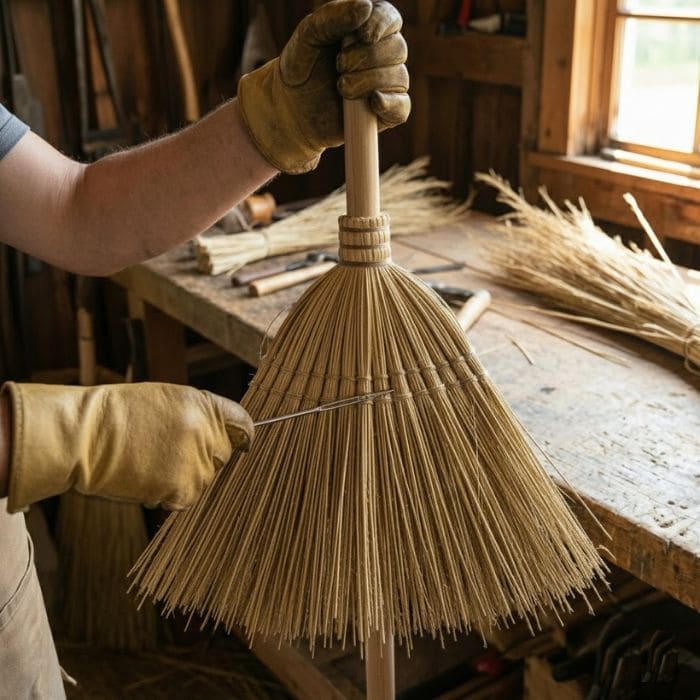
The most impressive moment came when the broom was pressed into a flat fan shape.
A cheap broom stays round and becomes messy with time. This one was forced into a purposeful shape, wide and controlled, and then came the step I didn’t expect.
The maker stitched across the broom’s face, sewing through the broomcorn to keep the fan shape locked in place.
The stitching wasn’t decorative. It was structural. It prevented the broom from flaring too wide and losing stiffness, and it made the broom sweep in a clean line instead of scattering everything sideways.
When the stitching was done, the broom looked finished, but more importantly, it looked stable. It looked like it would still be sweeping well months from now, after thousands of strokes.
Leaving the Workshop With a New Kind of Respect
When we walked back outside, the village felt even quieter than before, as if the workshop had tuned my attention differently.
I looked at the buildings, the fences, the straight paths, and it made sense that this community would be known for making practical things beautifully, because what I had just watched wasn’t about craft as a hobby.