Here’s the Longest Mountain Range I’ve Ever Seen
I thought I understood what “long” meant when it came to mountains, because before this drive, Amanda and I had spent plenty of time moving alongside the Cascade Range, watching volcanoes like Mount Hood and Mount Rainier appear and disappear as the road curved north and south, and that range already felt impressive enough to…
I thought I understood what “long” meant when it came to mountains, because before this drive, Amanda and I had spent plenty of time moving alongside the Cascade Range, watching volcanoes like Mount Hood and Mount Rainier appear and disappear as the road curved north and south, and that range already felt impressive enough to frame entire states.
But the Rockies taught me something different, something humbling, because they don’t just appear beside the road, they stay with you, mile after mile, state after state, long enough that your sense of scale quietly gives up trying to measure them.
We began this particular stretch in northern New Mexico, near the Sangre de Cristo Mountains, where the southern edge of the Rocky Mountains rises abruptly from high desert and open grassland.
The first morning, the light was thin and pale, the kind that makes colors feel honest rather than dramatic, and the peaks stood there with a quiet confidence, not sharp or theatrical, but broad and solid, like they had settled into their place centuries ago and weren’t interested in being admired.
Starting in New Mexico, Where the Rockies Feel Unexpected
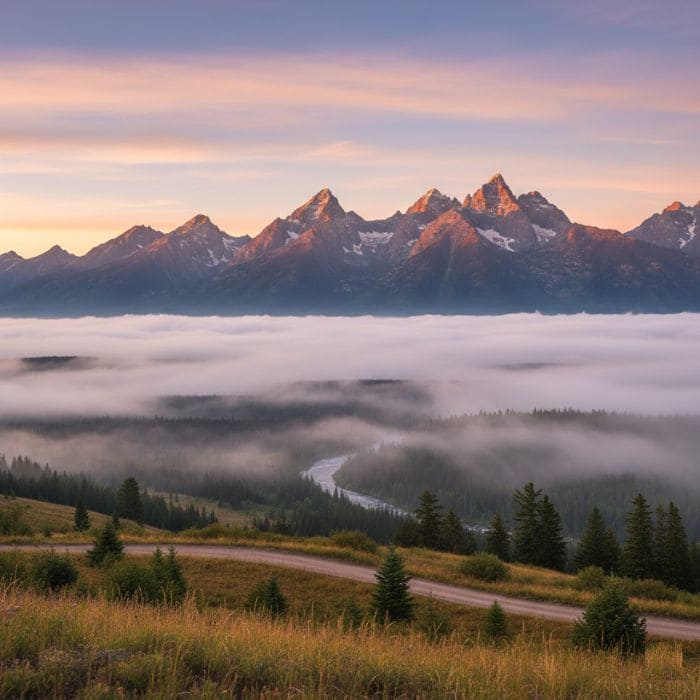
What surprised me most about starting in New Mexico was how gently the Rockies introduce themselves.
You don’t arrive at towering, snow-packed drama right away. Instead, the mountains grow out of mesas and plains, their slopes covered with piñon pine and scrub, their ridgelines stretching far enough that it’s hard to tell where one mountain ends and the next begins.
Driving north through this part of the range, I kept noticing how the mountains didn’t demand attention with height alone.
They demanded it with continuity. You crest one rise, expecting a break, and another line of peaks appears beyond it. Then another. Then another.
Two Days of Driving, and Still Inside the Same Range
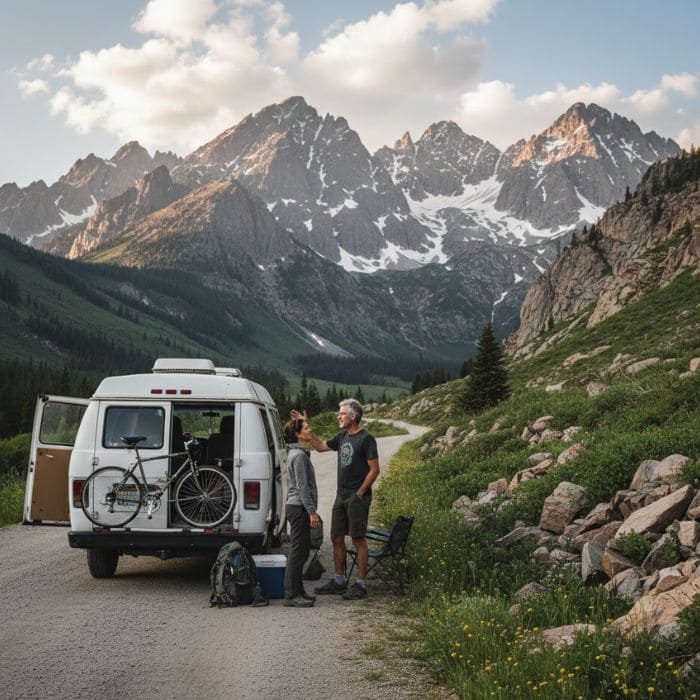
By the end of the first day, we had crossed into Colorado, moving through areas where the mountains grow taller, colder, and more layered. Forests thickened, the air sharpened, and snow still clung to shaded slopes even when the valleys below felt warm enough for open windows.
We stopped occasionally just to stretch our legs, and every time we stepped out of the van, the silence felt deeper than expected, as if the mountains absorbed sound instead of echoing it back.
The second day blurred state lines in a way only long mountain drives can. Wyoming came and went without ceremony, and still the Rockies remained, stretching out ahead of us like a promise that refused to resolve.
At some point, I realized I had stopped asking when they would end, because the answer no longer mattered. The mountains had become the context rather than the destination.
That’s when it hit me that this range runs for roughly 3,000 miles, from Canada all the way down to New Mexico, and that even after two full days of driving, we were still just moving along one long chapter of something much bigger than our route.
Why the Rockies Felt Completely Different
I kept thinking about the Cascade Range as we drove, partly because we know it so well and partly because we had crossed it just two months earlier.
The Cascades stretch for roughly 700 miles, and we followed that range for a full day, spending about eight to nine hours driving alongside it, watching the familiar silhouettes of volcanoes rise cleanly from the landscape, then fade away again as the road shifted.
The Cascades feel bold and defined, almost theatrical in the way each peak introduces itself. Mount Hood, Mount Rainier, Mount Shasta, each one stands alone with a clear identity, like a sentence that knows exactly where it begins and ends.
You see them, you name them, you stop for photos, and then, eventually, the range releases you and lets the road move on.
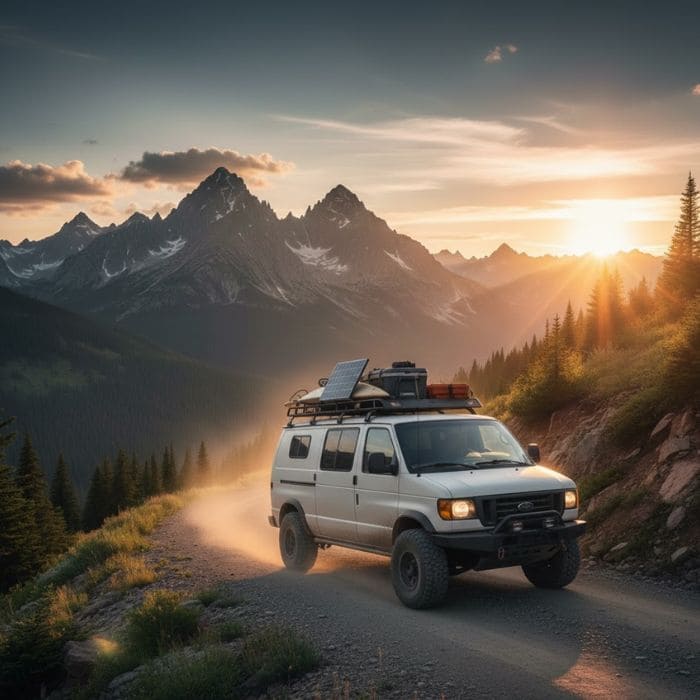
The Rockies never do that. They don’t offer closure or a clear exit point. They stay with you, stretching far beyond your peripheral vision, refusing to break themselves into neat highlights.
Instead of dramatic individual peaks, they unfold slowly, almost stubbornly, shifting from desert foothills to forested slopes, then into high alpine passes and wide valleys shaped by ancient ice.
The changes happen so gradually that hours can pass before you realize the entire landscape has transformed around you.
At some point, Amanda said something that captured it perfectly. She said the Cascades feel like punctuation marks, clear and striking, while the Rockies feel like a paragraph that keeps going, long enough that you stop looking for the ending and start paying attention to texture instead.
In the Rockies, the details take over, the way rivers carve through valleys, the way tree lines rise and fall with elevation, the way weather moves in without warning and reshapes the mood of the land in minutes.